2 years ago
Friday, February 28, 2014
New Arrival 02/28/2014
Monday, February 24, 2014
Tee'd off during the Ice Storm
Closing the Ravenel bridge for multiple days because of ice really messed things up for Charleston in February. Businesses were crippled, schools were closed and everyone was irate about the way everything was handled. I wasn’t happy about it myself. The thing that was talked about very little during the whole debacle was the time we were fortunate enough to spend stuck at home with our families in the middle of the week. I became daddy day care as my 18month old son and I finger painted, built blanket forts and played every game imaginable to pass the time. It wasn’t until the second episode of the ice apocalypse that I realized the time I took for granted. My brother invited me to play with him in the Northern Trust PGA Pro Am. Luckily my travel plans were not delayed because of the storm. We were paired to play with PGA elite Jim Furyk. While everyone in Charleston was once again stranded at home because of ice, I was playing golf in 75 degree weather at the Riviera Country Club in California. I learned two things during this wonderful trip. First, my golf game could use some work. Second, when you receive advise from a former US Open Champion golfer you should listen. Furyks advise, “Slow down, take your time and enjoy the moment.” He was mostly talking about my golf swing, but I took it to heart. Furyk could not have been a more personable person to spend the day with playing golf. He talked constantly about his wife and kids, his own father and his unending passion for all sports. He made me realize how fortunate I was to be invited by my older brother to spend a few days reconnecting with each other. He told me to talk my time on my golf swing, but I realized that isn’t the only thing I need to take my time on. He helped me understand that being stuck at home with your toddler when you have a long list of things that need to get done at work is a blessing. |
Upping Stones
Do you remember the horse and buggy days. I don't either, but we have two distinct reminders of them every time we walk around the historic downtown. The first is the parade of tourists being carted around by donkeys leaving large droppings on our streets marked with little orange flags. "Watch your step." The second are these large stones that trip us up as we avoid a runner out enjoying the spring time air. The stones are referred to as "upping stones."
Over a century ago all residents used horse and buggies to navigate Charleston, not just the tourists. "Upping stones," or carriage steps, were used to tie down their horses or climb onto the carriage. The stones are usually granite, marble, limestone or brownstone. There are actually a few stones downtown made of quartz. These stones began appearing in Charleston as early as the 18th century. The low-country does not have any native stone, so most of the stones arrived via ship from the Northeast. Some still remain in place today as a status symbol of historic authenticity. Or laziness, because they are to heavy to move. A recent study by College of Charleston anthropology student Craig Garrison noted that there are at least 105 such stones scattered throughout our city.
His research states that Charleston has a greater number and variety of these stones than any other city in American. Garrison's 40 page report chronicles the dimensions style and notable features of the "upping stones" in Charleston. Take a look at his report A Catalog of Carriage Steps it is really interesting. The city does not hold a current code for the preservation of these stones. They are just another wonderful aspect that tends to be naturally preserved in our historic town. These stones traveled thousands of miles to get here and have remained in the same place for over 150 years. Take a moment to appreciate their beauty. Just be careful not to hit them with your car door the next time you park downtown.
Over a century ago all residents used horse and buggies to navigate Charleston, not just the tourists. "Upping stones," or carriage steps, were used to tie down their horses or climb onto the carriage. The stones are usually granite, marble, limestone or brownstone. There are actually a few stones downtown made of quartz. These stones began appearing in Charleston as early as the 18th century. The low-country does not have any native stone, so most of the stones arrived via ship from the Northeast. Some still remain in place today as a status symbol of historic authenticity. Or laziness, because they are to heavy to move. A recent study by College of Charleston anthropology student Craig Garrison noted that there are at least 105 such stones scattered throughout our city.
His research states that Charleston has a greater number and variety of these stones than any other city in American. Garrison's 40 page report chronicles the dimensions style and notable features of the "upping stones" in Charleston. Take a look at his report A Catalog of Carriage Steps it is really interesting. The city does not hold a current code for the preservation of these stones. They are just another wonderful aspect that tends to be naturally preserved in our historic town. These stones traveled thousands of miles to get here and have remained in the same place for over 150 years. Take a moment to appreciate their beauty. Just be careful not to hit them with your car door the next time you park downtown.
Monday, February 3, 2014
AIA / ASLA Continuing Education
Friday March 21st, 12:00-1:00 Credits: 1.0
Alliance Designer Products
Contractor Ready Advanced Formula Training on Polymeric Sand.
Course Summary:
The objective of the course is to explore the difference between all the ICP joint stabilization options that are on the market. We will discuss the natural and chemical makeup of jointing material. How to avoid the most common failure issues. You will learn the proper installation techniques and product expectations. The course will explore the life cycle of the product and how natural and man-made occurrences define them. This program will fulfill requirements for AIA, ASLA and ICPI for continuing education.
|
Thursday, January 16, 2014
New Arrival 01/16/2014
Check out our winter "Blues -tone"!
Wednesday, January 8, 2014
Gaillard Center's Big Year
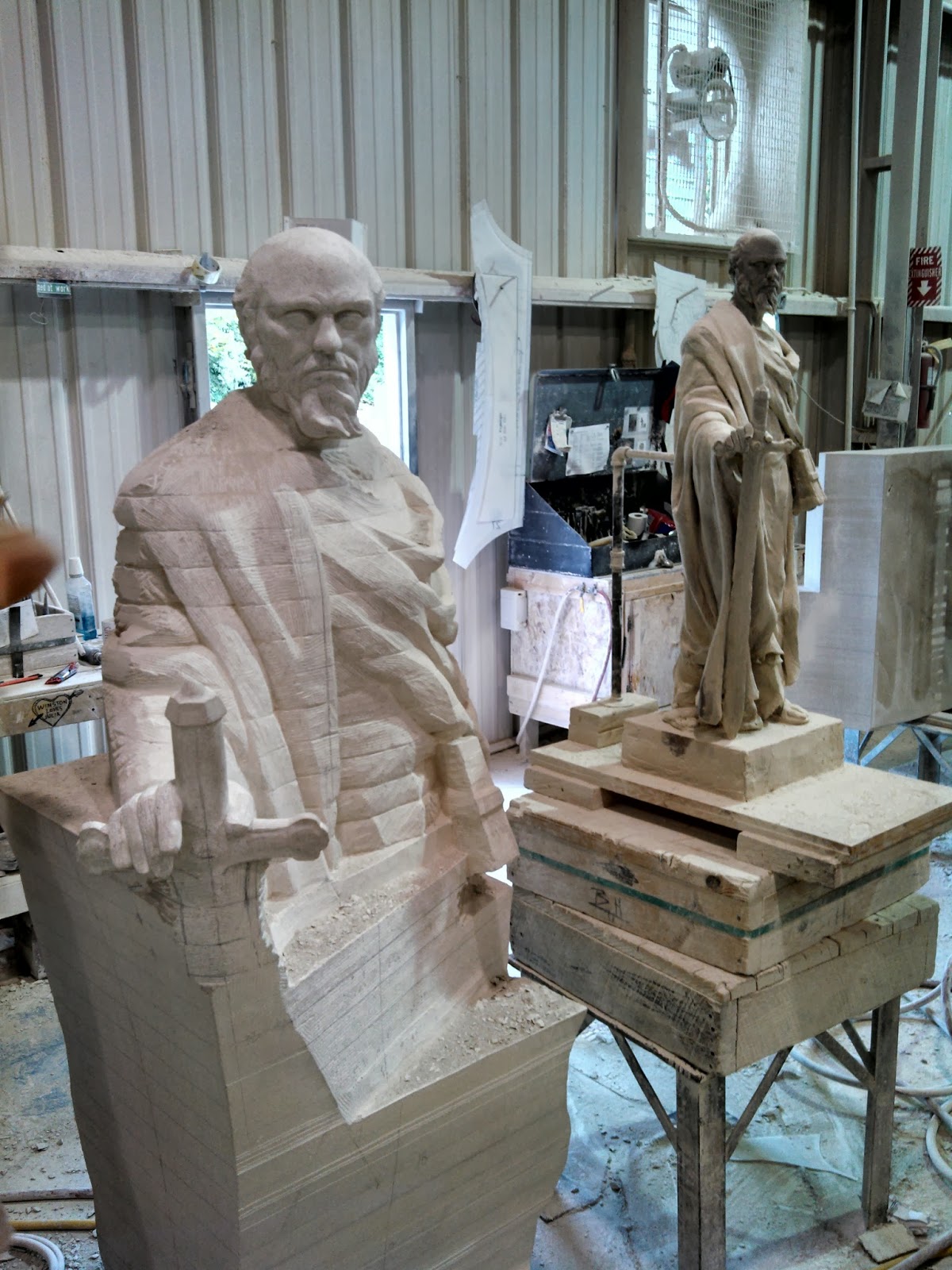
The Gaillard Center Renovation is bound to be the talk of 2014. It has many Charleston residents awestruck with the elaborate design, detail and planning involved in the $150 million makeover. Robert Behre wrote in the Post and Courier, "It may be the most expensive building ever built in Charleston that is not technically speaking, a building." One of the most important factors in this project is going to be time. They have already estimated that set backs could cost the city up to $2 million in extra costs. The amount of time that the BAR spent in the review stage set back many of the timelines from the start. The city has faced other obstacles since then, finding human remains dating back over 250 years, delaying the project for several weeks. A new turn of events in the weather is not going to help the cause. The Granite on the base course of the building is being produced by a company in Quebec, Canada where the temperature is hovering around -5 degrees. The overall building's facade is a mixture of limestone and stucco. The limestone is being fabricated by a company just outside of Bloomington, Indiana called Bybee Stone that has faced blizzard conditions for over a week and struggled to work. Bybee Stone Company has been contracted to furnish over 26,400 cubic feet of Indiana Limestone. That is approx. 2000 tons of natural stone that all has to be hand crafted material. Bybee has half a dozen of its 71 employees working on the project. These stonecutters are operating lathes, air hammers, chisels and finishing tools to crave the intricate design elements seen in the image above. They are currently working on a piece of stone at the main entrance that weighs over 12,000lbs. I have included some pictures of the limestone fabrication in my blog. Hopefully, a break in weather will assist in their progress. I will continue to blog about the Gaillard Center Renovation as the timeline continues to unfold.
|
Thursday, January 2, 2014
The Death of Santini
The Death of Santini: The Story of a Father and His Son by Pat ConroyMy rating: 4 of 5 stars
I love spending the holidays sitting back to relax and spend some much needed quiet time with my nose buried in a book. Luckily for me, my family must also, because they continue to fill my Christmas stocking with wonderful books year after year. A newly released gem by our very own Lowcountry powerhouse Pat Conroy was released in November. “The Death of Santini,” is the sequel to a previously released best seller called the “Great Santini.” Although, this new release is not his best book to date, it certainly delivers what Pat Conroy worshippers (like me) want to read. Essentially, the memoir retells many of the stories that Conroy fictionalized in his greatest works. He recounts them in depth and gives the reader a glimpse inside how each story made him feel and impacted his life. The largest subject in the book was Conroy’s father Don. Portrayed in the movie “The Great Santini,” by Robert DuVall, the mere thought of Don Conroy in real life brings back feelings of hatred to his son Pat. This book is different because he attempts to forgive his father and the rest of his family for their shortcomings and admit many of his own. The title of the book is not the only journey the reader receives. Conroy delivers a strong message about the death of his brother, his dysfunctional sister and his up and down relationship with his mother after her divorce. I enjoy reading Conroy’s books because of the language. As you read you can feel the effort and devotion he puts toward selecting each and every word on the page. These words connect with the reader in a unique fashion. As Conroy works his way through the characters in his life you start to believe them as your own. The book really has no plot. A shortcoming that will keep it from the bestsellers list, but the reader will walk away with a better understanding of themselves. I am able to resurrect my own childhood memories while reading his stories. A constant juxtaposition of hope, depression, hate and fortitude make Conroy’s novels worth the read.
View all my reviews
Subscribe to:
Posts (Atom)